On Factor Model Construction
Single-factor strategies capture one dimension of return. Composites capture several while reducing exposure to any one failing.
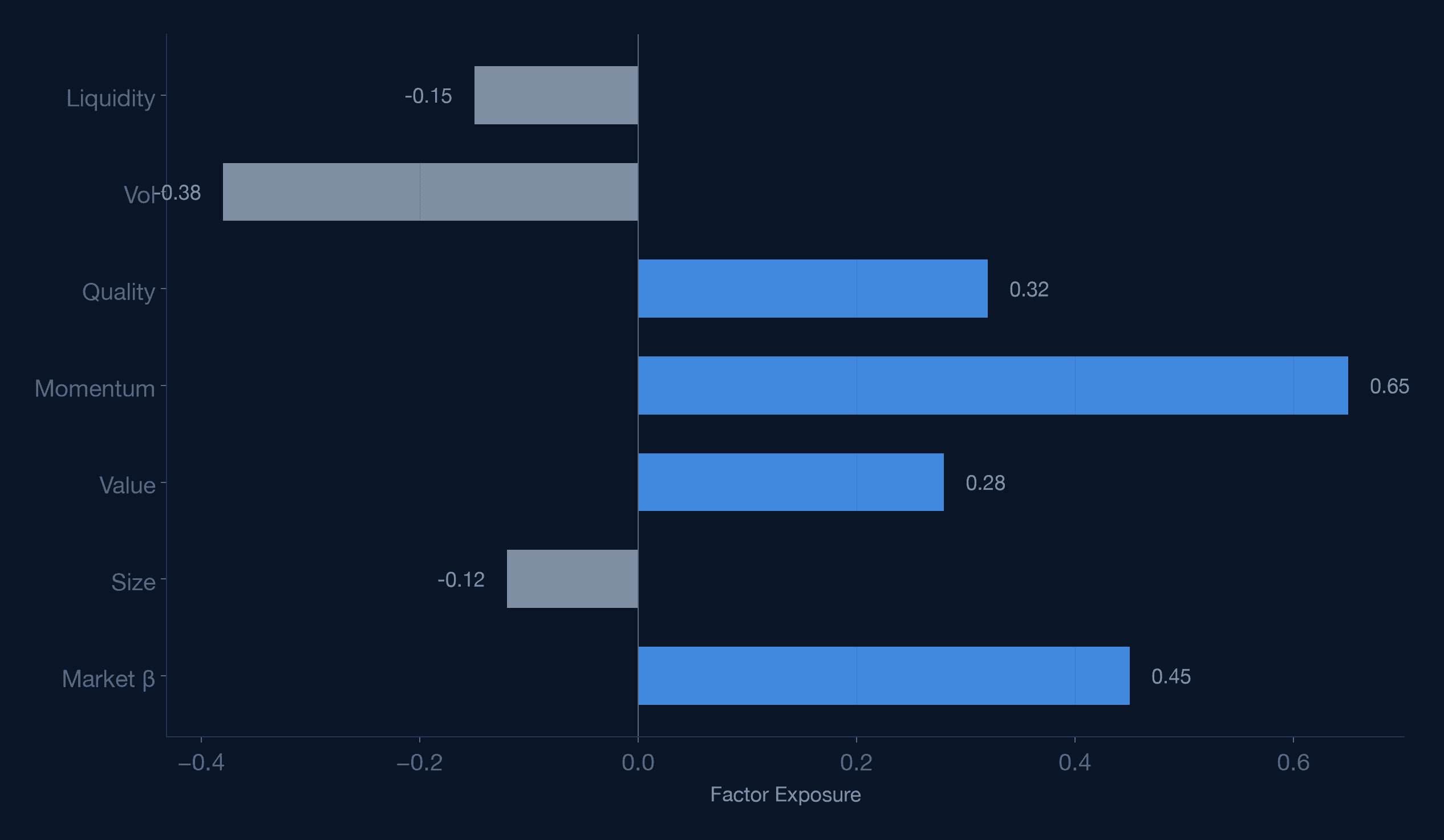
The academic literature identifies several persistent sources of cross-sectional return: value (Fama and French, 1992), momentum (Jegadeesh and Titman, 1993), quality (Novy-Marx, 2013), and low volatility (Baker, Bradley, and Wurgler, 2011). Each factor has periods of strong and weak performance. A strategy built on one factor alone is exposed to extended drawdowns when that factor underperforms.
We construct composite signals by combining multiple factor scores into a single ranking. The combination weights are not optimized on historical data. They are set equal or based on economic reasoning. Optimized weights tend to overfit to the sample period and degrade out of sample.
Each factor score is computed from standardized cross-sectional ranks, not raw values. Ranking removes the influence of outliers and makes signals comparable across factors with different units. A stock that ranks in the top decile for both value and momentum receives a higher composite score than one that ranks highly on only one dimension.
We test the composite against each individual factor using walk-forward validation. The composite must outperform its components on a risk-adjusted basis out of sample. If it does not, the combination adds noise rather than signal, and we discard it.
Factor Model Specification
We extend standard multi-factor models with momentum and quality factors. Factor scores are computed using cross-sectional percentile ranks rather than raw values, which neutralizes the effect of outliers and makes scores comparable across factors with different units and distributions. Composite signals weight factors equally unless economic reasoning justifies otherwise — optimized weights tend to overfit the sample period.
The descriptions above are for educational and informational purposes only and do not constitute investment advice. Past performance is not indicative of future results. See full disclosures.
References
- Fama, E. F. and French, K. R. (1992). “The Cross-Section of Expected Stock Returns.” Journal of Finance.
- Jegadeesh, N. and Titman, S. (1993). "Returns to Buying Winners and Selling Losers." Journal of Finance.
- Novy-Marx, R. (2013). "The Other Side of Value: The Gross Profitability Premium." Journal of Financial Economics.
- Asness, C., Moskowitz, T., and Pedersen, L. (2013). "Value and Momentum Everywhere." Journal of Finance.