Regime Detection in Strategy Allocation
A strategy that works in low volatility may fail in a crisis. Position sizing should reflect the current regime, not the average regime.
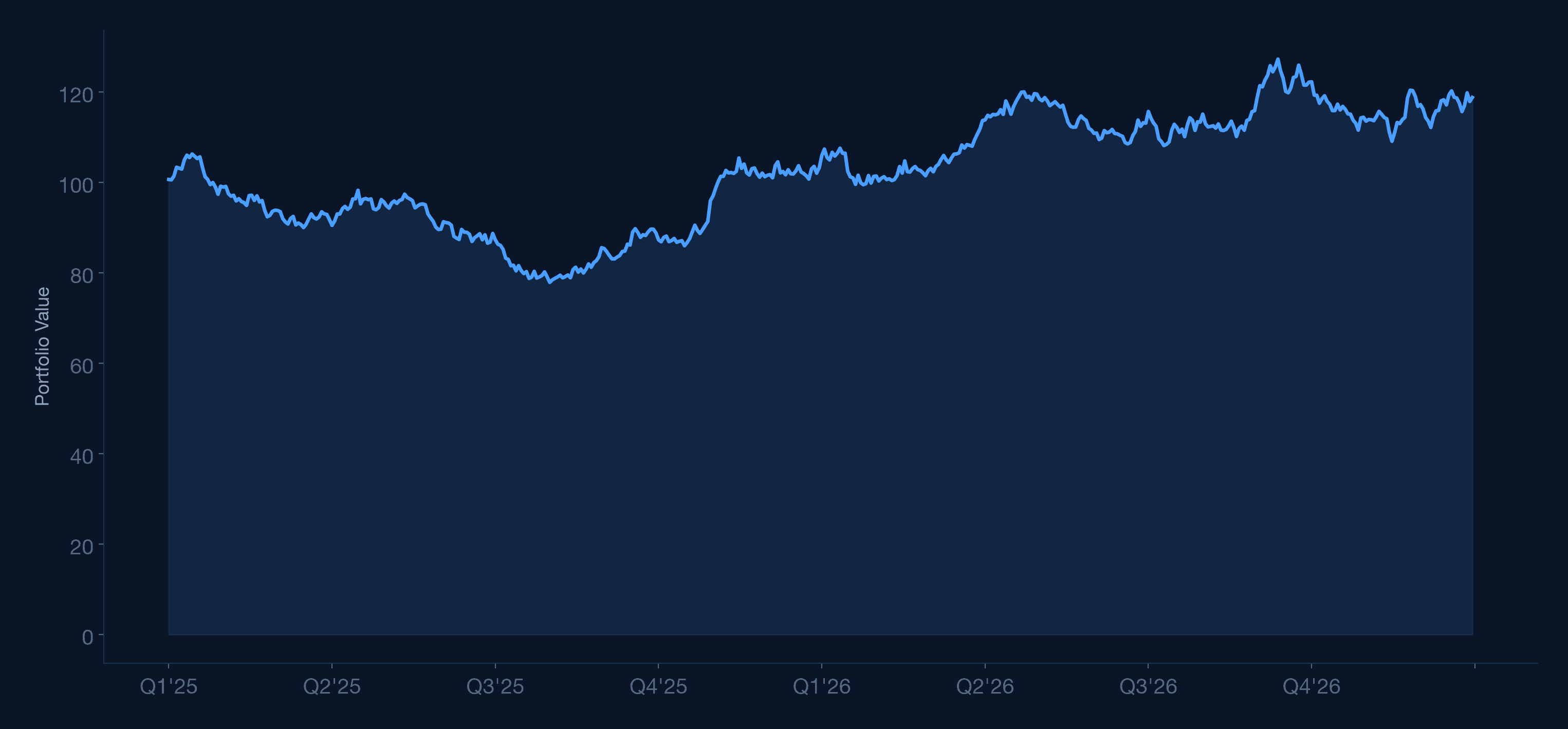
Markets move between distinct regimes: low volatility trending periods, range-bound consolidation, and high volatility crisis episodes. A strategy backtested across all regimes produces an average performance number that may not represent any actual trading environment. Mean-reversion strategies tend to work in ranging markets but fail in strong trends. Momentum strategies do the opposite.
We classify regimes using realized volatility ratios and VIX term structure. When short-term realized volatility exceeds long-term realized volatility by a threshold, the market is in a high-volatility state. When the VIX futures curve inverts (backwardation), it signals acute stress. These classifications are computed from observable data with no forward-looking information.
Position sizes are scaled by regime. In low-volatility environments, strategies run at full allocation. In high-volatility regimes, tactical positions are reduced by 50%. In crisis regimes, tactical exposure drops to zero and only the core allocation remains. This scaling is automatic and rule-based. It does not require a judgment call during a drawdown.
We test each strategy separately by regime using conditional walk-forward validation. A strategy must show positive out-of-sample performance in at least two of three regime types to qualify. A strategy that only works in low volatility is fragile. A strategy that works across regimes has a more durable edge.
Regime Classification
We classify market regimes using a composite of realized volatility ratios and term structure signals. Short-term volatility relative to long-term volatility determines the regime state, with the VIX term structure providing independent confirmation.
When near-term VIX futures trade above longer-dated contracts (backwardation), it indicates institutional hedging demand and acute stress. Position sizes are scaled automatically based on the detected regime — reduced during elevated volatility and minimized during crisis conditions. Both signals must agree for the system to remain in a normal classification.
The descriptions above are for educational and informational purposes only and do not constitute investment advice. Past performance is not indicative of future results. See full disclosures.
References
- Ang, A. and Timmermann, A. (2012). "Regime Changes and Financial Markets." Annual Review of Financial Economics.
- Hamilton, J. D. (1989). "A New Approach to the Economic Analysis of Nonstationary Time Series and the Business Cycle." Econometrica.
- Kritzman, M., Page, S., and Turkington, D. (2012). "Regime Shifts: Implications for Dynamic Strategies." Financial Analysts Journal.