Walk-Forward Validation
The only honest test of a strategy is performance on data it has never seen.
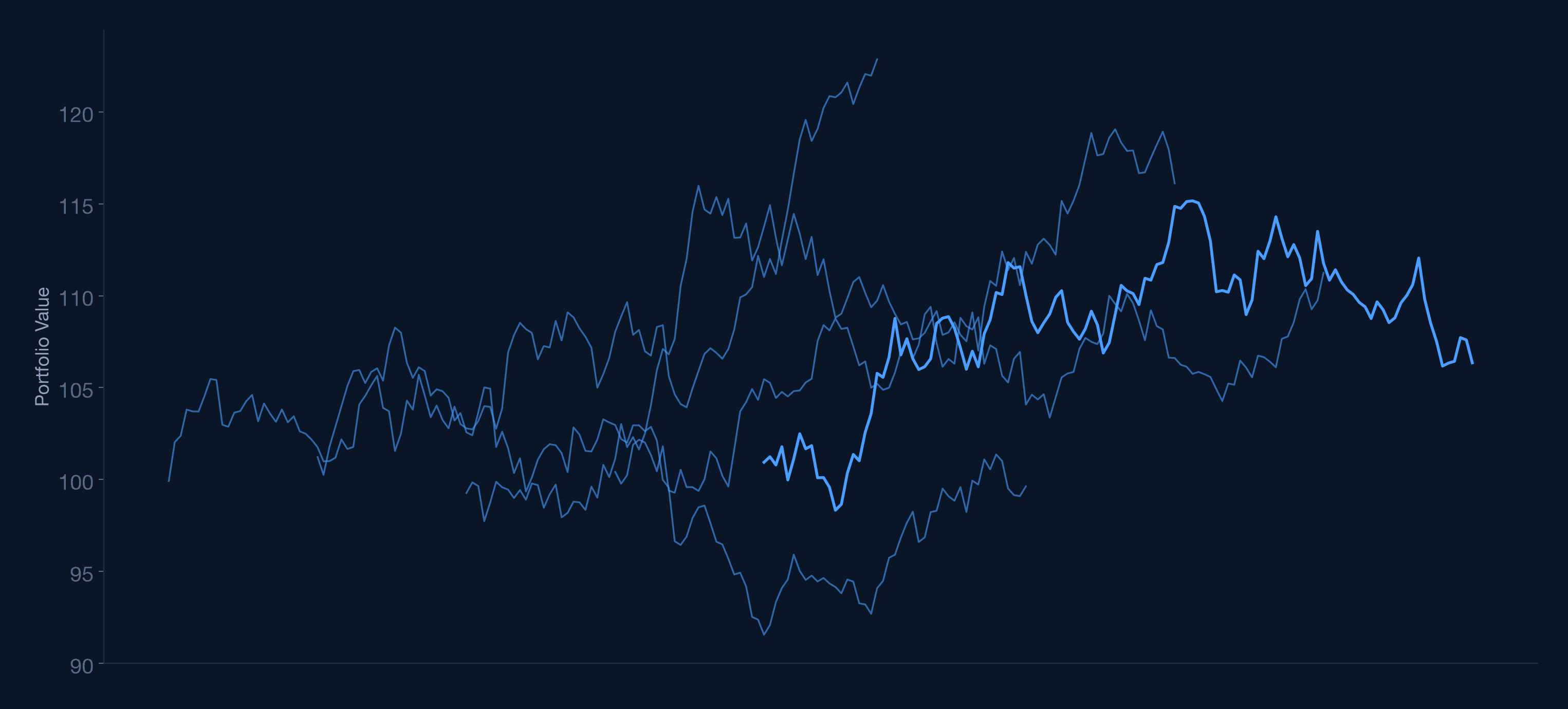
Standard backtesting trains and evaluates a strategy on the same historical data. This conflates pattern recognition with prediction. A strategy may identify a pattern that existed between 2015 and 2020 but has no basis for persistence.
Walk-forward validation addresses this by splitting the data into sequential train and test windows. The strategy is optimized on the training period, then evaluated on the subsequent test period that was not available during optimization. This process repeats across multiple expanding windows.
We support both expanding windows, where the training set grows over time, and rolling windows, where the training set moves forward with a fixed length. A strategy must demonstrate consistent out-of-sample performance across multiple windows. A single good window is not sufficient.
This methodology is not novel. It is standard practice at institutional quantitative funds. We apply it because strategies that fail walk-forward validation have no place in a portfolio, regardless of their in-sample statistics.
Measuring Fold Consistency
A strategy that performs well in one out-of-sample window but poorly in others is unreliable. We measure consistency by evaluating risk-adjusted performance across multiple out-of-sample folds, penalizing strategies that concentrate returns in a single period.
A strategy that appears strong in aggregate but derives most of its return from one favorable window will be correctly flagged as unreliable. Consistent performance across multiple market environments is required — a single good fold is not sufficient.
The descriptions above are for educational and informational purposes only and do not constitute investment advice. Past performance is not indicative of future results. See full disclosures.